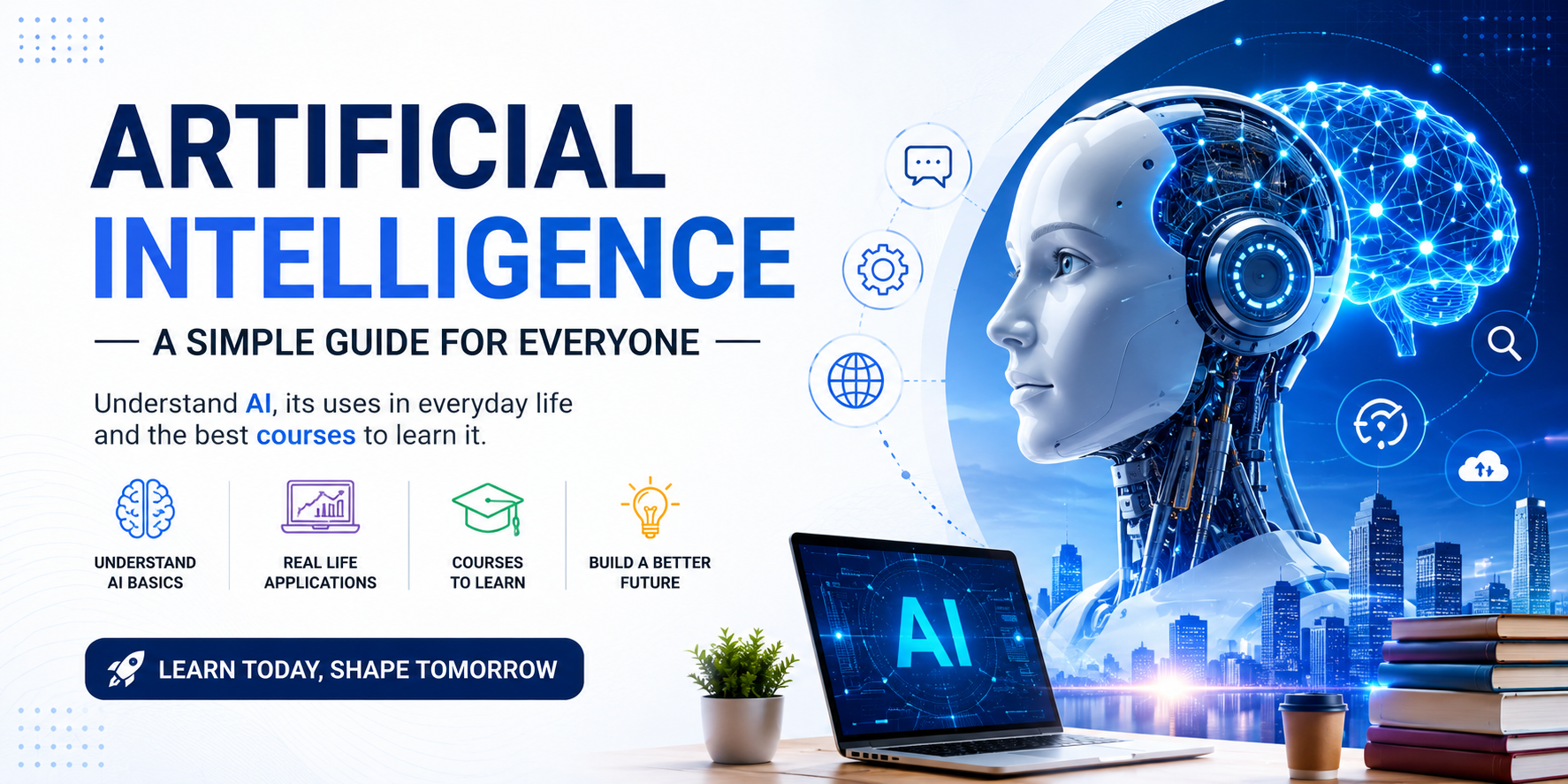
Artificial Intelligence, or AI, is becoming a part of our everyday lives. We may not always notice it, but we use AI in many different ways—from searching on the internet and watching recommended videos to using smartphones, online shopping, maps, banking apps, and voice assistants.
But what exactly is Artificial Intelligence? Why is everyone talking about it? And should students and ordinary people learn about it?
Let’s understand AI in simple words.
Artificial Intelligence is a technology that allows computers and machines to perform tasks that usually require human thinking.
For example, humans can recognize a face, understand a question, translate a language, find information, or make a decision based on what they know.
AI allows computers to perform some of these tasks too.
In simple terms, AI helps computers learn from information and perform useful tasks in a smart way.
You don’t need to be a computer expert to understand the basic idea.
AI is already around us.
When YouTube or another video platform recommends a video you might enjoy, AI may be involved in deciding what to show you.
When a smartphone recognizes your face to unlock the device, AI technology can help identify you.
When an online shopping website recommends products, AI can analyze information about products and customer activity.
When a map application suggests a route or estimates travel time, computer systems use large amounts of information to provide useful results.
Even when you speak to a voice assistant or use an AI chatbot, you are interacting with artificial intelligence.
One common misunderstanding is that AI is only for programmers, engineers, or technology professionals.
That is not true.
Understanding AI can be useful for almost everyone.
A student can learn how AI works and use AI tools for learning.
A teacher can explore AI-based educational tools.
A business owner can learn how AI may help with everyday business activities.
A professional can use AI to save time on certain tasks.
Even parents can benefit from understanding the technology their children are increasingly using.
You don’t have to become an AI engineer to understand AI.
The world is changing rapidly, and technology is becoming an important part of almost every profession.
Students who understand AI can become better prepared for the future.
Learning about AI can help students:
Most importantly, students should learn how to think and learn with technology, rather than simply depending on technology to do everything for them.
An AI course does not always have to be complicated.
Beginner courses can explain AI using simple examples and everyday applications.
Depending on the level of the course, students may learn about:
What AI is, how it developed, and where it is used.
This simply means teaching computers to recognize patterns from information and use those patterns to make predictions or decisions.
This is the technology behind AI systems that can create things such as text, images, computer code, summaries, and other content.
Students can learn how different AI tools can assist with studying, writing, research, creativity, productivity, and other activities.
Understanding AI is not only about learning what it can do. It is also important to understand its limitations.
AI can sometimes provide incorrect or misleading information. Therefore, people should check important information and use their own judgment.
No—not necessarily.
If you simply want to understand AI and learn how to use AI tools, you can start without knowing programming.
For students who later want to build AI systems or pursue technical AI careers, learning programming and mathematics can become important.
Therefore, there are different levels of AI education.
For beginners: Learn what AI is and how it is used.
For regular users: Learn how to use AI tools effectively and responsibly.
For future technology professionals: Learn programming, mathematics, data, machine learning, and advanced AI.
Students can choose courses according to their interests and current level.
Ideal for students and adults who are completely new to AI.
It can cover basic concepts, everyday applications, AI tools, opportunities, and responsible use.
This type of course focuses more on practical use of modern AI tools for learning, creativity, research, and productivity.
Students interested in the technical side of AI can begin learning Python programming and gradually move toward AI and machine learning.
This is a more advanced option for students who want to understand how computers learn from data.
This is one of the biggest questions people have about artificial intelligence.
AI can automate certain tasks, but human abilities remain extremely important.
People provide creativity, judgment, emotions, communication, responsibility, experience, and understanding of real-world situations.
Rather than thinking only about “AI replacing people,” it may be more useful to think about people learning to work effectively with AI.
The ability to use new technology wisely may become an important skill in many careers.
AI can also become a useful learning companion.
For example, students can use AI tools to:
However, students should not simply copy AI-generated answers.
The real purpose of education is to understand, think, question, and learn.
AI should support education—not replace learning.
You don’t need to learn everything at once.
A simple path is:
Start with the basics → Understand everyday AI → Try beginner-friendly AI tools → Learn how to use AI responsibly → Explore courses → Develop deeper skills according to your interests.
Even spending a little time regularly learning about AI can make the subject much easier to understand.
Artificial Intelligence is developing quickly, and new applications are appearing regularly.
The people who benefit most from technology are not necessarily those who know everything about it. They are often the people who are willing to learn, adapt, and use technology wisely.
Whether you are a student, parent, teacher, professional, business owner, or simply someone interested in the future, learning the basics of AI can be a valuable investment in knowledge.
Artificial Intelligence may sound complicated, but the basic idea is simple: AI is technology that enables computers to perform tasks that involve aspects of human intelligence.
You don’t need to be a programmer to start learning about it.
Start with simple concepts, understand how AI is used in everyday life, explore beginner-friendly courses, and gradually develop your knowledge.
SunshineLearning.in aims to help learners discover useful knowledge, educational opportunities, and emerging technologies in a simple and understandable way.
Keep learning. Keep exploring. Keep moving towards the future.